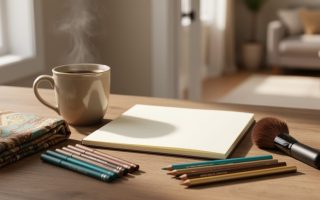
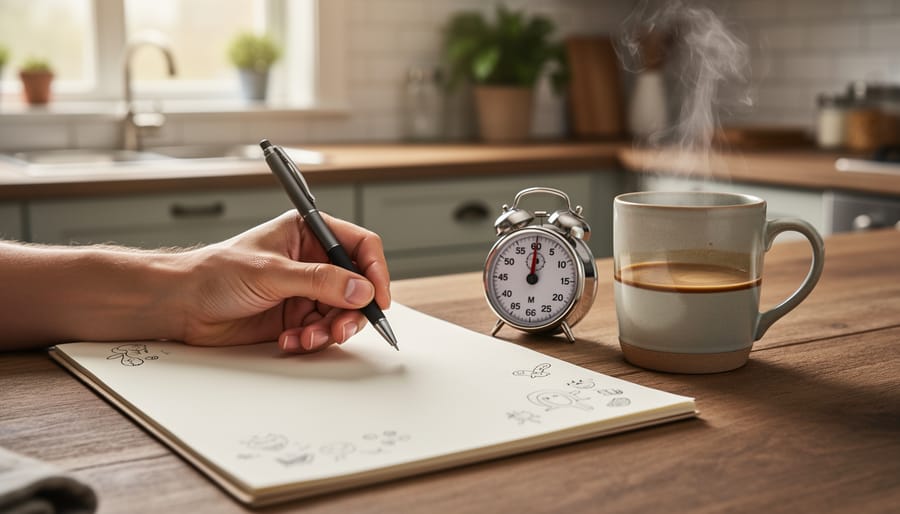
You can spark fresh creative thinking in just five minutes with focused exercises that require nothing more than a pen, paper, and your imagination. These quick creative bursts fit seamlessly into coffee breaks, morning routines, or those precious quiet moments between dropping the kids off and diving into your work inbox. They’re designed to shake loose mental cobwebs, generate new ideas for your cooking experiments or personal style choices, and remind you that creativity isn’t reserved for people with hours of free time.
I stumbled onto the power of micro-creativity during a particularly overwhelming spring when my calendar felt like a Tetris game I was losing. Rather than waiting for that mythical “creative retreat” weekend, I started setting my phone timer for five minutes each morning. The shift was remarkable. Those tiny pockets of creative play didn’t just generate ideas; they changed how I moved through my everyday moments making me more observant, more playful, more willing to try that unexpected ingredient combination or jewelry pairing.
The exercises ahead tap into different creative muscles, from visual thinking to word play to sensory exploration. You’ll confirm they’re working when you notice yourself spotting connections you’d normally miss, feeling more energized rather than drained, and actually looking forward to these brief creative breaks.
What You’ll Need to Get Started
The best part? You already own everything you need. These exercises don’t require a trip to the craft store or any special setup. I designed them specifically for real life, the kind where you’re squeezing creativity into the margins of your day.
Here’s what you’ll use across the five exercises:
- Your phone camera (the one already in your pocket)
- Paper and a pen, or the notes app on your phone
- Whatever’s currently in your fridge, pantry, or spice rack
- The makeup or skincare products sitting on your bathroom counter
- Clothes already hanging in your closet
That’s it. No shopping list, no Amazon cart, no waiting for supplies to arrive. You can start any of these exercises right now, whether you’re stealing five minutes before the kids wake up, during your lunch break, or while waiting for dinner to finish cooking. The point is removing every possible barrier between you and a creative moment. If you can grab a pen or open your closet, you’re ready to begin.
Before You Begin: Setting Yourself Up for Success
The best creative breakthroughs happen when you’re relaxed, not when you’re forcing brilliance. Before you dive into these exercises, give yourself permission to be messy, imperfect, and even a little silly. There’s no one watching, no grade to earn, and no “right” outcome. If you catch yourself thinking, “This is stupid” or “I’m not doing this well enough,” that’s just your inner perfectionist talking. Acknowledge it, then keep going anyway.
Pick moments when you have actual energy to spare. If you’re completely wiped out at the end of a long day, that’s not the time to force a creative exercise. Wait until morning coffee, a lunch break, or those few minutes before dinner when you’re present enough to engage. These exercises work because they’re short, not because they’re miracles. Five minutes means five minutes. You don’t need to turn one exercise into a full project or spend fifteen minutes trying to make it “count.” Do the thing, notice what happened, and move on. That’s enough.
Five 5-Minute Creative Exercises You Can Do Today
Exercise 1: The Ingredient Remix Challenge
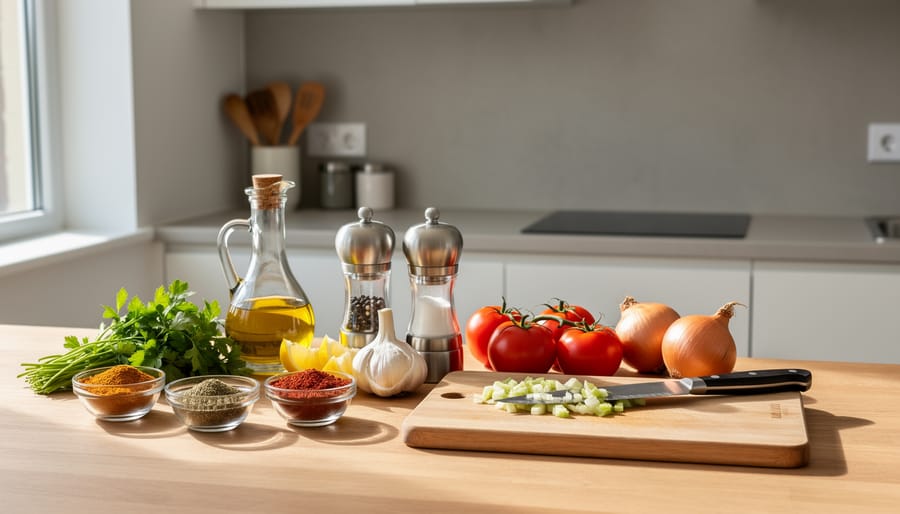
This exercise turns your kitchen into a creativity lab without any prep work. You’re not actually cooking anything, you’re training your brain to see new connections between familiar flavors.
- Set your phone timer for 5 minutes and head to the fridge or pantry.
- Without overthinking it, grab the first three ingredients that catch your eye. They can be anything: a jar of pickles, some leftover rice, a can of chickpeas, honey, frozen peas, whatever’s there.
- Place them on the counter and look at them together. Your job is to imagine one dish or flavor combination that uses all three in an unexpected way.
- Jot down your idea, it can be as simple as “pickle-honey glaze for roasted chickpeas” or as elaborate as a full meal concept. Don’t judge whether it would actually taste good.
- When the timer goes off, you’re done. Put the ingredients back and move on with your day.
The magic happens when you pair things you’d normally never consider together. Maybe you pulled out strawberries, balsamic vinegar, and cheddar cheese, suddenly you’re thinking about a savory-sweet grilled cheese. Or coconut milk, curry powder, and blueberries lead you to an unusual breakfast porridge idea.
You’ll find yourself noticing flavor possibilities during regular cooking that you would’ve missed before. That’s your creative muscle getting stronger.
Exercise 2: The Beauty Product Swap

Stand in front of your bathroom mirror and grab any makeup or skincare product within reach. Your mission? Use it for something completely different than what’s written on the label.
Start by choosing one item, a lipstick, eyeshadow, bronzer, or even a tinted moisturizer. Set your timer for 5 minutes and decide on a new purpose. That berry lipstick? Dab a tiny amount on your cheeks and blend with your fingertips for instant cream blush. Shimmery eyeshadow can become highlighter when swept across cheekbones. Bronzer doubles as eyeshadow. A rich lip balm softens cuticles or tames flyaway hairs.
Apply the product to its new home and observe what happens. Does the texture blend easily? Does the color surprise you? Take a moment to really look at the result before you decide whether you love it or laugh it off.
The beauty of this exercise is that nothing is permanent, everything washes away in seconds. You’re training your brain to see familiar objects with fresh eyes, challenging the rigid categories we assign to everyday items. Some experiments will delight you. Others will teach you exactly why that product comes with specific instructions. Both outcomes count as creative wins.
Exercise 3: The Closet Surprise Mix
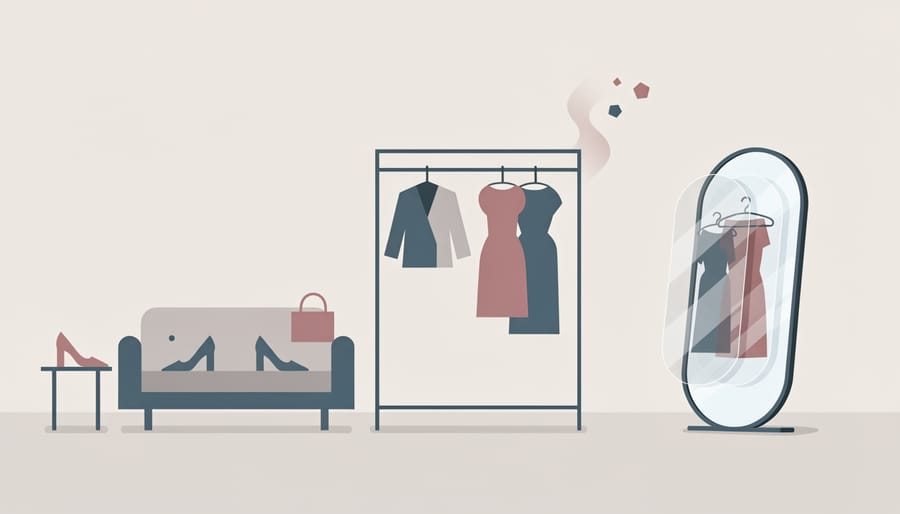
Stand in front of your closet, phone timer set for 5 minutes. Close your eyes and reach in twice, grabbing whatever your hand lands on first. No peeking, no swapping, whatever comes out is your challenge.
Now open your eyes. You might be holding a silk scarf and cargo pants, or a blazer and a sundress. The point isn’t whether it “should” work, it’s discovering if it can. Try them on together. Belt the blazer over the dress. Knot the scarf through a belt loop. Layer in ways you’d normally dismiss.
This exercise short-circuits the mental rules you’ve built around your wardrobe. We all develop patterns: this top only goes with jeans, that skirt is too fancy for daytime. But those are assumptions, not laws. When you force random pairings, you stumble onto combinations that feel fresh because they bypass your usual styling tips and logic.
Take a quick mirror selfie of anything that surprises you in a good way. You won’t remember these spontaneous wins otherwise, and they’re gold for those mornings when getting dressed feels stale. Even if the pairing doesn’t work, you’ve stretched your style imagination, and that pays off long after the timer stops.
Exercise 4: The Snapshot Story
Grab your phone and set a timer for 5 minutes. Your challenge is to capture five photos of everyday objects or scenes that evoke a feeling or tell a tiny story.
Start moving through whatever space you’re in right now, your kitchen counter, the living room, your bathroom vanity, the view from your window. Look with fresh eyes, as if you’re seeing these familiar things for the first time. What catches your attention? The morning light hitting your coffee mug a certain way, the jumble of your daughter’s hair ties on the dresser, the wilting bouquet you forgot to toss.
Don’t overthink composition or worry about Instagram-worthy shots. You’re hunting for moments that make you pause, details that stir something, nostalgia, humor, peace, curiosity. Each photo should whisper a micro-story: “She was here” or “This morning felt quiet” or “I need to call her.”
When the timer goes off, review your five images. Notice what you chose and why. This exercise rewires how you see your daily surroundings, training you to spot beauty and narrative in the ordinary clutter of life. You’ll start noticing more throughout your day, even when the camera isn’t in your hand.
Exercise 5: The Rapid-Fire Idea List
Grab a piece of paper and pen, yes, actual paper works better here than your phone because there’s no autocorrect to slow you down. Pick one category that’s been nagging at you lately: dinner ideas for the week, birthday gift possibilities for your sister, fun weekend outings with the kids, or even topics you’d love to learn more about.
Set your timer for 5 minutes and start writing every single idea that pops into your head, no matter how silly, impractical, or half-formed it seems. The goal is speed, not brilliance. Don’t pause to evaluate whether “taco night but make everything purple” is a good idea or not. Don’t cross anything out. Don’t worry about spelling. Just keep your pen moving across the page like you’re racing against yourself.
When the timer goes off, step away for a minute. Then come back and scan your list. You’ll almost always find two or three genuinely useful ideas buried among the wild ones, and sometimes the wild ones spark something even better. I once wrote “cookie dough face mask” during a beauty brainstorm (terrible idea), but it led me to an actually great brown sugar scrub recipe.
This exercise works because your inner critic needs time to wake up and start judging. In 5 minutes, you outrun it completely.
How to Know It’s Working (and What to Do Next)
The shifts happen quietly. You might catch yourself daydreaming about a new recipe while folding laundry, or reach for an unexpected scarf without overthinking it. These small moments, when creativity starts showing up uninvited, are the clearest signs your exercises are working. You’re not just completing tasks anymore; you’re seeing possibilities where routine used to live.
Other signs include feeling less stuck when problems arise, noticing colors or textures you’d normally overlook, and actually wanting to try the ideas you generate. If you find yourself naturally tweaking the exercises to fit your mood or schedule, that’s not cheating, it’s proof you’ve internalized the benefits of creativity and made them yours.
Ready to build on this? Try rotating through different exercises each week, bumping up to 10 minutes when you have space, or inviting your kids or partner to join. Jotting down your favorite discoveries in a notes app or journal helps you spot patterns and celebrate growth. Drop a comment below telling us which exercise clicked for you, we’d love to hear what’s sparking joy in your everyday routine.
Your Questions About Quick Creative Exercises
What if I don’t feel creative after one try?
That’s completely normal. Creativity isn’t a light switch that flips on instantly, it’s more like a muscle that strengthens with practice. Try the same exercise a few times, or switch to a different one that feels more natural to you.
Can I do these with kids?
Absolutely! Kids often thrive on these quick bursts of imagination. The Ingredient Remix and Snapshot Story work especially well with children, and you’ll be surprised how their unfiltered ideas inspire your own thinking.
Do I need to do all five exercises?
Not at all. Pick one that speaks to you and make it your own. Some people rotate through all five over a week, while others stick with a favorite. There’s no wrong approach to creativity enhancement.
What if I don’t have 5 uninterrupted minutes?
Even 2 or 3 minutes counts. Pause an exercise midway and return to it later, or break it into smaller chunks. The timer is a guide, not a rule, what matters is showing up, however briefly.
Is it okay to modify the exercises?
Please do! These exercises are starting points, not strict formulas. Adjust them to fit your life, interests, and energy levels. Your version might end up being even better than the original.
The beauty of quick creative exercises is their flexibility. They’re meant to fit around your life, not demand you reshape your schedule. If something doesn’t click right away, give yourself permission to experiment until you find what works.